Indigo!

Before I came, I read that the region of Japan where the pilgrimage starts is famous for producing indigo. I didn’t think I’d get to experience it, since I was focusing on temples. But when your partner’s in the hospital, you have some time to kill, and yesterday (Sunday 3/15) I took a train and a bus up north to a wee historical museum where you can try out indigo dyeing.
Guess what: I loved it.
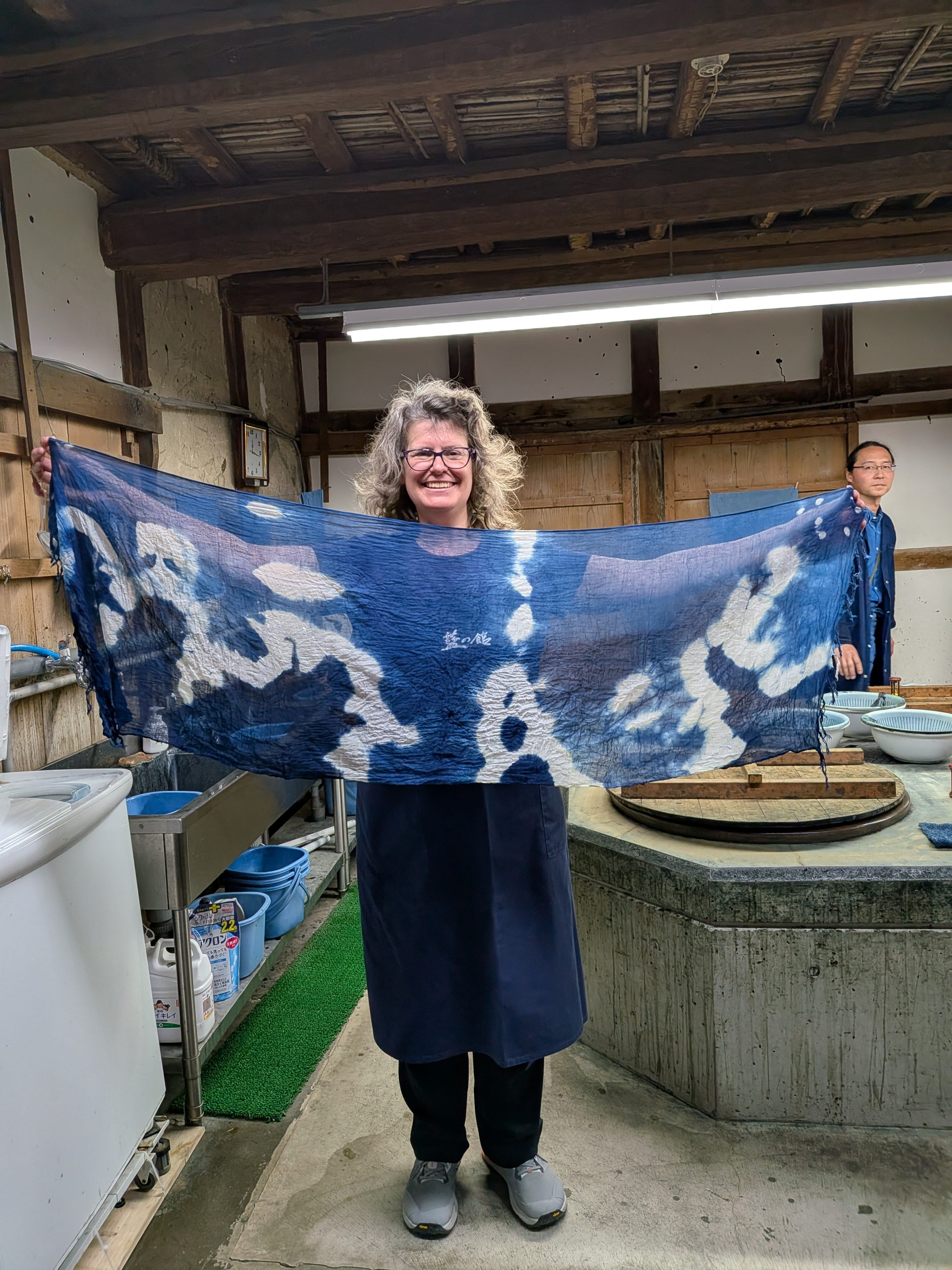
First you pick the item you want to dye, from a little washcloth-sized towel up to a huge silk stole. I went for the big cotton gauze stole on the theory that I already have a lot of silk scarves.
They have examples of traditional patterns on the wall to choose from, but the Hungarian (!) woman who was helping me apparently sized me up and thought I might be into deviating from the instructions. She’s lived here for 18 years - she went to design university in Hungary, then moved to Tokushima to study indigo dyeing, got married, and here she is, helping tourists try out indigo a few days a month at the museum. She showed me how to prepare the fabric - I kind of scrunched it up and fastened a pair of wooden clappers across it to make the big white bands, then added some clothespins to make the little white dots you can see near my hand at the top right.
After preparing the fabric, she walked me over to the huge vats of dye, lifted the cover off one, and scooped off the foam on top. The process is to hold the piece under the surface of the dye for at least a minute, squeezing and squishing the fabric, then take it out, opening up the fabric so the dye has a chance to oxidize for at least a minute. Then you repeat as many times as you want, to get a darker color. I dipped the whole piece three times, then the bottom edge three more times for a darker color. The last step is to rinse it thoroughly in plain cold water, then give it a quick trip through the spin dryer.
I opened it in the workshop and we all oohed - I was going for a kind of sea-and-land-with-horizon effect but ended up with a Pillars of Creation vibe and I love it. I ironed it to dry it the rest of the way.
Indigo is the classic dye for blue jeans and even though jeans generally aren’t dyed with indigo today (wayyyyy too expensive) the dye should behave they do over time, fading in the light and with abrasion.
The museum is built around a lovely set of historical buildings - apparently this region of the Yoshino River valley is full of the mansions of indigo merchants, which I kind of wish I’d known the week before last, when I was walking through the area visiting the first 10 temples of the pilgrimage. It would have been fun to keep an eye out for them.
The river used to flood all the time, depositing rich soil that was great for growing the indigo plant. Those floods also meant you couldn't grow rice here. The museum had an example of a wooden boat that farmers would keep with them just in case they needed to escape a sudden flood.
I learned that the plant grown in these parts, Persicaria tinctoria, is just one of several plants used for indigo dye. It’s native to China and Vietnam, and was introduced to Japan sometime before the 1400s - it’s hard to pin down exactly when. Cotton took off in Japan sometime in the Edo period (1603-1868), and cotton and indigo get along really well together. My Hungarian helper told me that one of the vats had a very dark color that samurai would use to dye the cotton layer they wore under their armor, on the theory that it was protective somehow.
The historic buildings were lovely and you can tell this is a good museum because it has dioramas:
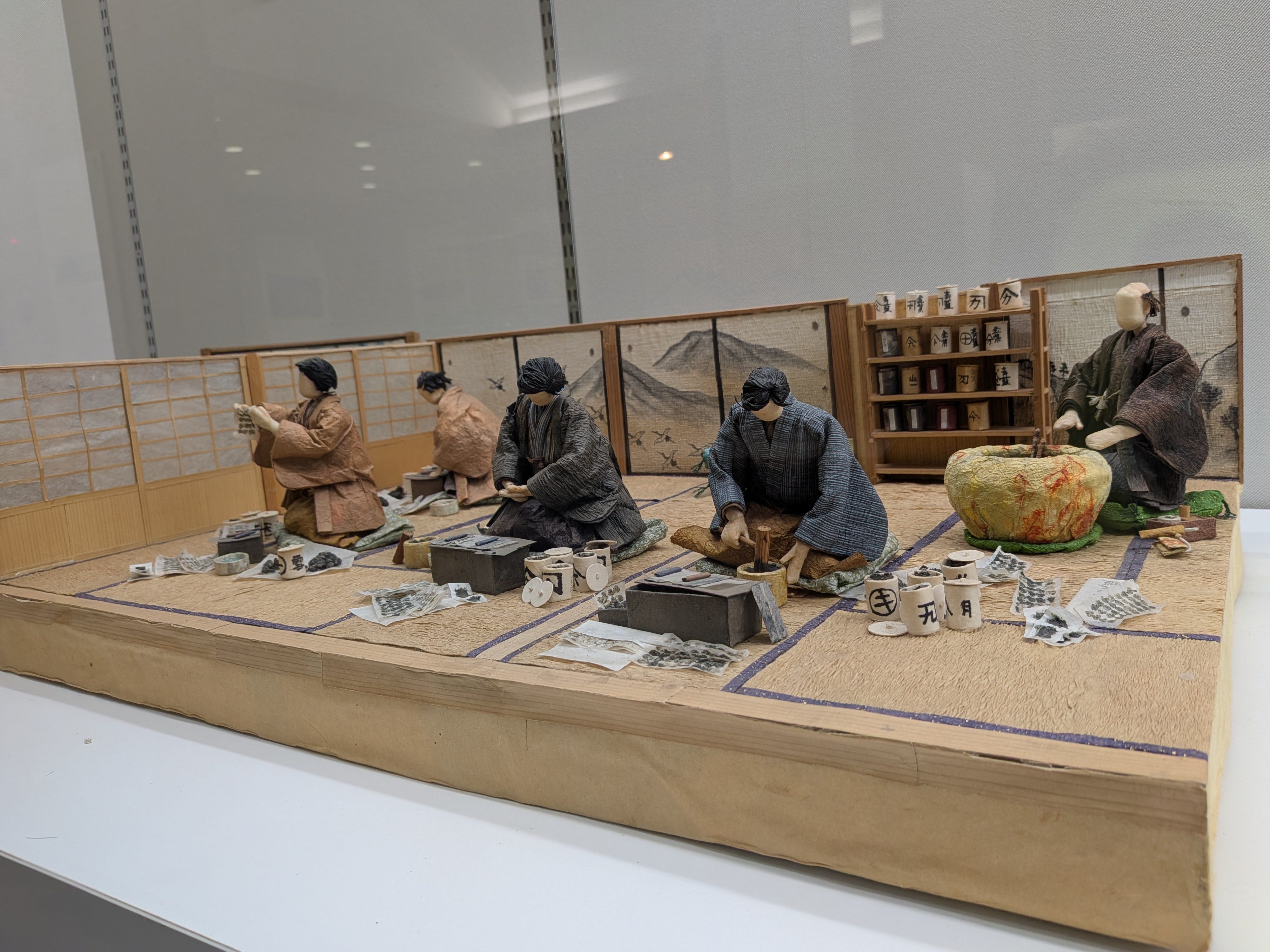
They also had most of their wall text in English, Korean, and Chinese, which I appreciate.
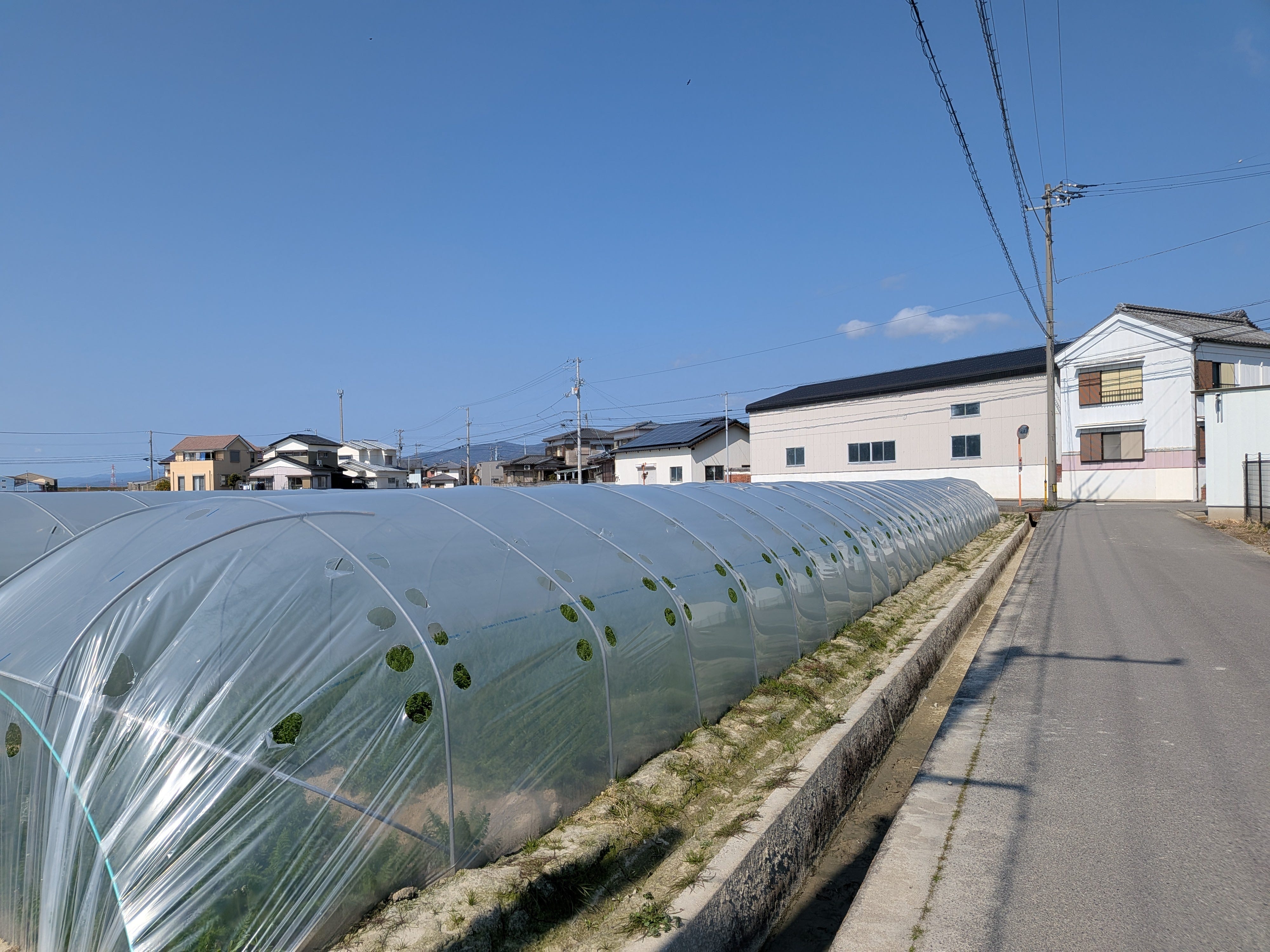
There’s a lot less indigo production here than there used to be. The rise of chemical dyes was a big part of that. Also flood control made it possible to grow rice and other crops. I was delighted to read in the museum that this is now a big area for spring carrots. We saw tons of carrots growing under long plastic polytunnels on our walk, and just that morning on the short walk from the bus stop to the museum I’d seen someone driving a wee harvester along a row of carrots in a field about the size of a house.
I’ve been considering my return to the pilgrimage with a mix of, I don’t know, resignation and dread? I know I’ve been talking about this pilgrimage for years, but the logistics are hard (I knew before I got here that this would be the worst thing). I tried to time the trip to start a bit before the busiest season. More than a week of delay due to illness means that I’m going to be trying to scrounge up places to sleep as the number of pilgrims increases greatly.
In the middle of last week I was like, forget it, I’m going home, but now I’m planning to keep going. I’m rethinking my plan, though. Instead of trying to walk most of the way, which means having to book farther and farther ahead at isolated inns to ensure I have places to stay at just the right distance apart - which means no flexibility in case of illness, or if I find a particularly interesting bug to look at, or if I just don’t feel like walking one day - I might try to stay in slightly bigger towns, visit temples by some combination of public transit and walking, and also get to some more tiny museums to learn about the history and landscape.
I never actually thought I was going to get to all 88 temples - 6 weeks isn’t long enough for the whole walk - and now the addition of public transit makes it feel like it might actually be possible? Maybe? Although, as mentioned, buses and trains are very infrequent here.
Sweetest part of Sunday’s adventure: Daniel and I had agreed ahead of time that I would just miss visiting hours and have an adventure instead, and when I was at the museum I thought that would happen; I didn’t want to cut my visit short (or my time in the gift shop across the street, let’s be real) to rush to the bus for the long, long trip back. The buses and trains around here are all really infrequent, and even more so on weekends. But then I realized: taxis exist! I had the nice woman at the front desk call me a taxi (she’d seen the photo of my dye experiment and was so excited about it) and arrived back at Tokushima station in plenty of time to get cash and buy myself a pork bun before catching a bus that stopped (after more than an hour) right in front of Daniel’s hospital, 25 minutes before the end of visiting hours.
Worst part of the adventure: I lost my beloved hat. I got it out to show my new Hungarian friend in the morning and when I went to put it on to leave Daniel’s hospital room in the evening, it wasn’t there. [Insert crying-face emoji.] I just made this hat in January and it’s perfect - I’m so proud of it. I’m hoping to get the hotel staff to call the bus company today in case I left it on board at the end of the day.
Very cool! That sounds like a great museum and a great experience.
Your thoughts about modifying your trip make a lot of sense to me. Much better to have time to stop for bugs and all the cool unplanned experiences you encounter, and also allow for the opportunity to visit interesting sites adjacent to the pilgrimage track.
Your new plan sounds like a good solution. Rooting for you!